
Product modelling in variant management (Part 6): One solution for all levels of complexity?

Solution spaces are expanding infinitely, variants are becoming ever more complex and configurators are increasingly difficult to maintain? We show field-tested methods and tools for modular variant toolkits and rule sets.

Recently, we had looked at the typical application scenarios and configuration strategies with a focus on the best user experience for customers, partners, sales and experts. However, configuration systems must cover all three core areas: modelling, configuration and automation.

State-of-the-art configuration systems and frameworks are the necessary basis for mastering all relevant scenarios and complexities and unlocking their full potential. The foundations for maximum efficiency and effectiveness in quotation and order processes are laid during modelling.

The modelling of configurators is often associated first with the definition of UX/UI, objects, classes, characteristics, values and rules. Many tried-and-tested methods: constraints, matrices, tables, formulae, scripting, pro-code and so on. Typical sales configurators are created quickly and easily. Results: valid characteristic evaluation, price calculation, quotation documents. So far, so good.

What is to be done in the face of constantly increasing complexity? A few examples: limitless solution spaces, hybrid system configuration, dynamic 3D visualisation, engineer-to-order automation. What is possible today? As an introduction, this article discusses methods and tools for complex variant modelling.

Modular variant systems for all levels of complexity

Modularly structured configuration models are based at their core on classification systems, object libraries, high-level and low-level rule sets, frontend definitions, open standard formats and integrations. Modelling is carried out by means of integrated development tools and specialised functional extensions for individual requirements. An open architecture enables the loose connection of external data sources, rule sets, automations and generators.

At the beginning of modelling, it is useful to describe the desired variants and permissible solution spaces. Structures, objects, properties, alternatives, options and dependencies must be taken into account. Variant trees are practical at first, but with increasing complexity they quickly become confusing. What helps in this situation? Structuring and modularisation.

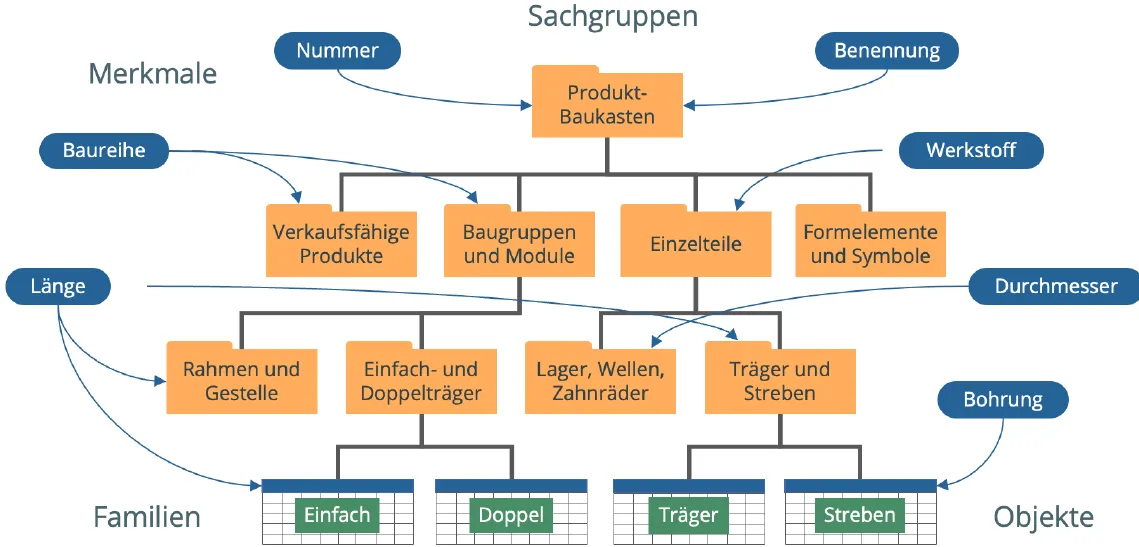
Configuration frameworks can map any complexity. How does that work? Top-down: complex variant trees are broken down step-by-step. Bottom-up: all relevant object variants are classified. Consequently, variant modular systems are based on class systems, families, objects and structures. It is very important to clearly distinguish between object classification and object structuring

Classification of the object variants

Objects are classified in classification systems, subject groups and family tables. Object properties are described using characteristics and values. Characteristics can cover many different areas: technical specifications, possible object relationships and parametrics, as well as organisation, logistics and status. Classification and characteristic valuation support object retrieval.

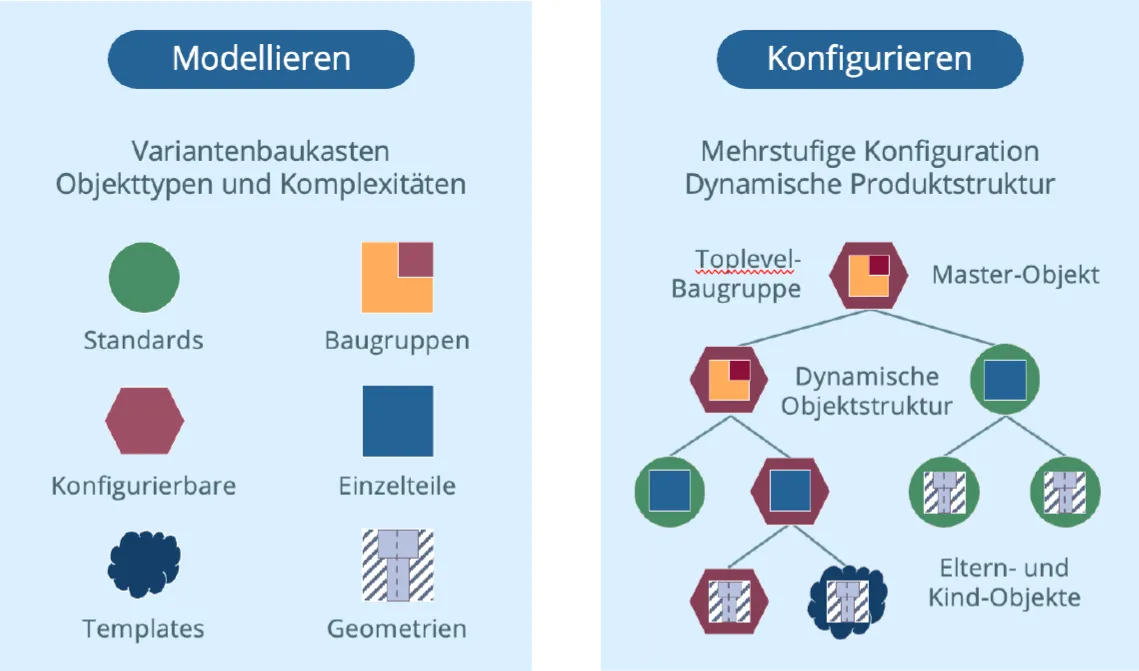
There are three further very important criteria for distinguishing modular system objects: Firstly: complexities – standard objects, configurable master objects or engineering templates. Secondly: usage types – top-level product or child object. Thirdly: object types – assemblies, single parts or geometry elements. These object types form the basis for object structuring.


Structuring of object variants

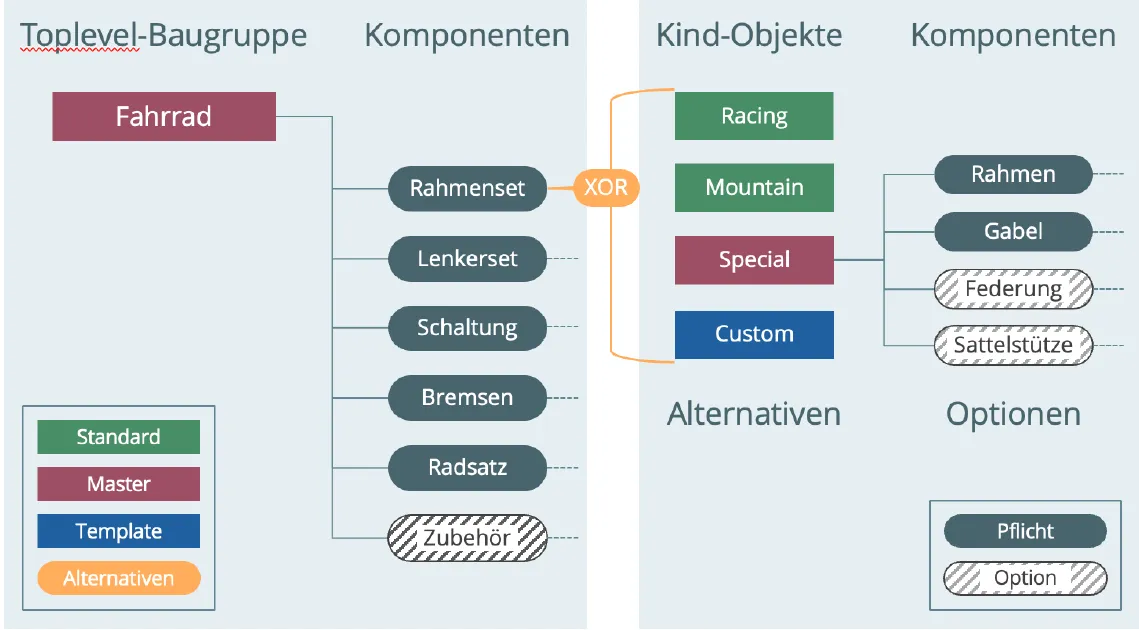
Variant structures are mapped using parent-child object relationships, very similar to modular bill of materials. Parent objects can have child objects, which in turn can have child objects and so on. This allows for any multi-level object structures. How are structure variants modelled?

Structural variants describe the possibility of options and alternatives. An optional child object is present or omitted. If there are multiple alternative child objects, one object must be selected from the group. During configuration, structural variance is controlled interactively or by a set of rules. It is also possible to find child objects by searching the classification system. Thus, the circle closes with object classification.


Low-level rule sets and dynamic object structures

Following the selection of the desired top-level object, a dynamic object structure is initially generated and continuously updated during configuration on the basis of characteristic values and rules. By dynamically controlling options and alternatives, the structure always contains the correct objects. The object types and complexities now fulfil important functions for rule-based configuration.

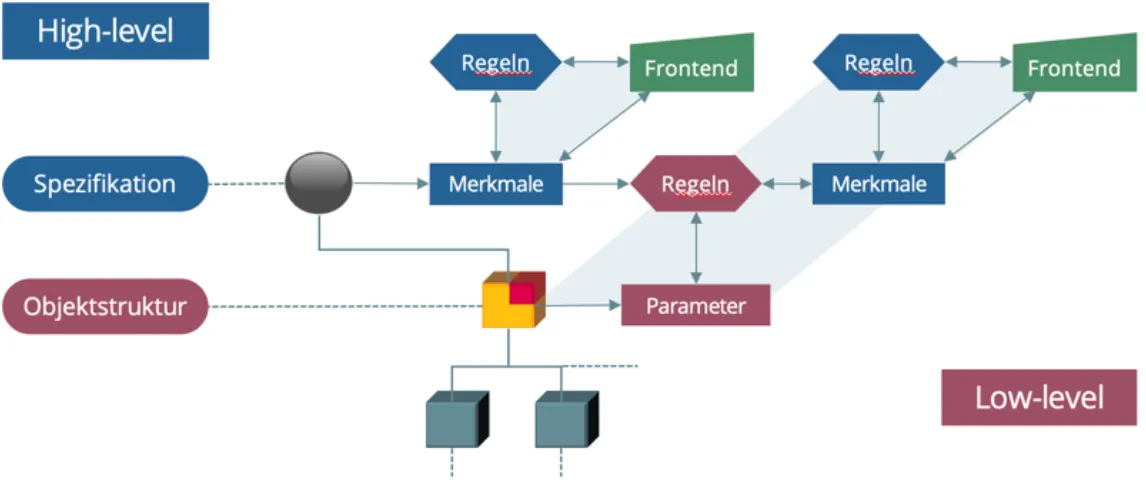
Structural variants, options, alternatives and dependencies between parents and children are low-level rule sets. Static standard objects have properties, but no rule sets. Configurable master objects bring local rule sets with them. Engineering templates can accommodate special requirements. With the aid of dynamic structural variants, modular systems, classification and object selection, a configuration system can master all levels of complexity.


High-level rulebooks and interactive configuration

Objects have properties, as do configurable master objects. Configuration characteristics and local sets of rules are particularly important here. The variance of master objects is realised by allowing configuration characteristics to take on variable values. Domains are specified as value ranges or value lists. Further dependencies can be defined between two or more characteristics. This local set of rules describes the object variance. The restriction of the variance of characteristics and values is the high-level set of rules.

The modularisation of all complex relationship knowledge is supported by dynamic structuring. Global rule set: requirements and solution finding at system or top level. Local rule set: object and structure variance of master objects. The configuration results are dynamically generated variant structures with all objects – standard objects, masters with characteristic evaluations, templates with requirements – as the basis for subsequent processes: visualisation, prices, costs, bills of materials, routings, spare parts, services …


Conclusion:

It's all about the right mix: variant modular systems, structuring, classification and modular rulebooks offer considerable benefits in managing complexity. The foundations for maximum efficiency and effectiveness are laid during the modelling stage.

What happens next?

Following this brief introduction to structured modelling methods, in the next post we will look at IT integration and automation. Big-bang approaches are rarely successful when it comes to strategically important projects. We examine agile and iterative project models and show how these can work very well in practice.

Andreas is Managing Director of adesso manufacturing industry solutions GmbH. He has many years of experience in software development and system integration in mechanical and plant engineering. His areas of expertise primarily include variant management and product, system and solution configuration

Andreas Liesche Managing Director of amis,Digital gearbox visualisation in a digital factory

Andreas Liesche

e-mail: andreas.liesche@adesso-mis.de