Application scenarios in variant management (Part 5): Best possible user experience for every target group

Specialised configurators for customers, partners, sales or experts? We demonstrate the best user experience and diverse possibilities for interactive configuration - flexible and optimised for user roles and application scenarios.

In the last post, we looked at methods and tools for smart variant management, all levels of complexity and core business processes, as well as tool-based and code-based modelling approaches for interdisciplinary teams.

In this post we discuss typical application scenarios and suitable configuration and modelling strategies, focusing on the best user experience, efficient and effective modelling. State-of-the-art configuration systems and frameworks support diverse methods, tools and functions. All the more important are good decisions for the best-suited solution approaches.

Controlled application dynamics – Everything secure and a lot possible?

An important success factor for the design, implementation and rollout of a configuration solution is, first and foremost, its reliable practical applicability. As the duration of use increases, release management becomes increasingly important, i.e. for master data, sets of rules and IT systems. If goals are set in a strategically sensible way at the beginning of a project, rapid progress and major successes are possible.

Let's start with basic concepts for good usability. Configurators must be intuitive to use and optimally tailored to user profiles: customers, partners, sales and experts. We distinguish between two basic application scenarios.

Secure configuration: guided and intuitive to use

For less experienced user profiles, safe navigation towards a correct and complete configuration result is the primary focus. To begin with, a valid initial configuration is generated. The set of rules is activated and prevents conflicts in advance. The user guidance allows steps forwards or backwards. The application is easy to understand, secure and goal-oriented.

adesso variant management configurator

However, typical problems can occur: early decisions cause constraints later on. Desired options might then no longer be available. Possible solutions are backtracking or restarts. Simple cases are easily resolved, but complicated cases quickly end in dead ends and abortions.

Open configuration: Maximum flexibility with a wealth of expertise

User profiles with specialist expertise can carry out very complex configurations. It is all about speed and flexibility on the path to the goal. The manageable variance is almost unlimited. Incomplete and invalid states are possible. The application supports free navigation through the solution space, interactive conflict management, alternative solution paths and special functions, such as integrated AI assistants.

adesso variant management configurator

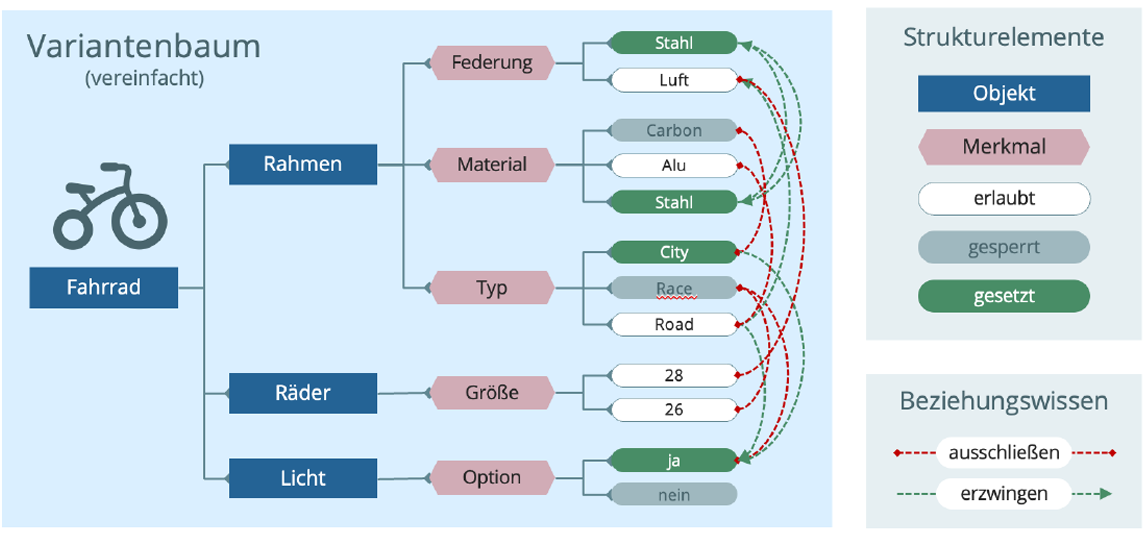
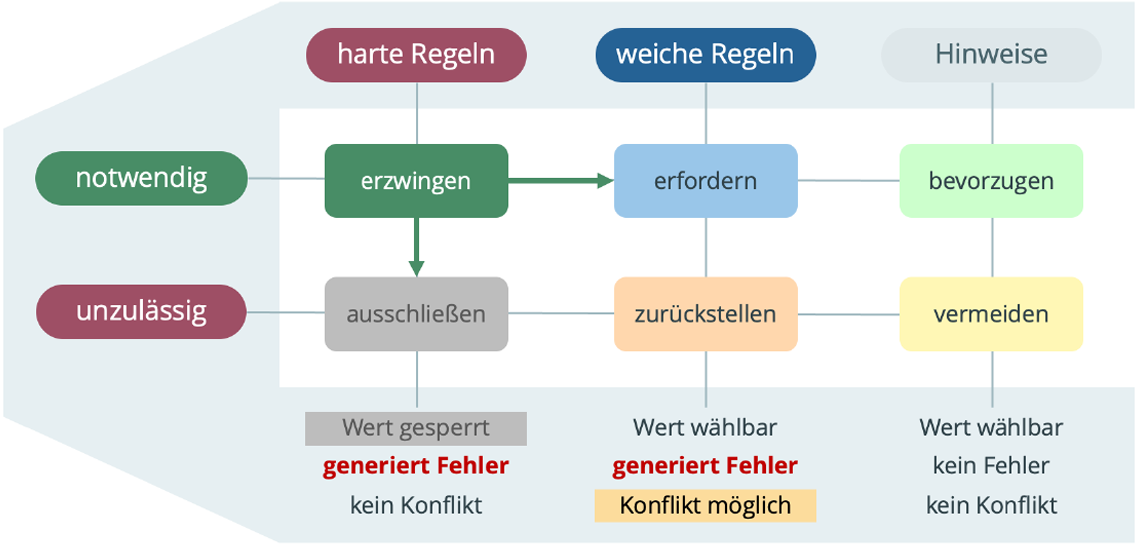
Expert configurators have many features: dynamic initial values, hard and soft rules, comparison of alternatives, conflict detection, calculations, filtering objects, controlling structural elements or generating model-driven UX/UI. Current innovations: algorithms optimise solutions for defined goals or AI assistants resolve conflicts and make suggestions. New technologies are the basis for exciting prospects and opportunities.

Product configuration or plant layout – Mastering solution spaces

What is being configured – products, systems or solutions? Variant configuration is simple or complex. We distinguish between complexity levels and use cases. A sensible delimitation of scenarios enables valid decisions for suitable modelling and application methods right at the start of the project.

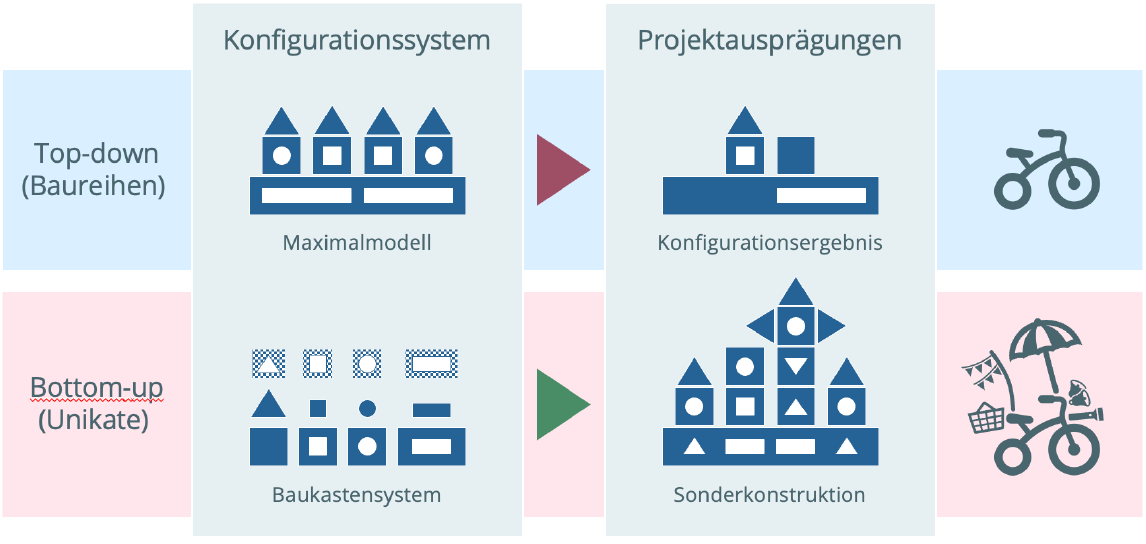
Top-down and bottom-up are typical modularisation techniques for kit and configuration systems. Two key objectives – maximum customisation and maximum reusability – must be balanced as effectively as possible. For implementation strategies and application scenarios, this means: configuring values and selecting options, or calculating, planning and assembling components and modules.

adesso variant management configurator

Top-down configuration: maximum model, alternatives and options

The top-down approach is well suited to modular products with predefined variations and limited solution spaces: defining a selection of configurable base products and expanding these with alternatives and options. In the modelling process, a 150% maximum model is created, comprising all conceivable predefined variants.

Interactive configuration is carried out by selecting values and options. The set of rules can directly set dependent values, exclude invalid values and select components. The solution space is precisely described, and only valid and complete configurations are permitted. In regulated innovation processes, redundant variants are removed and new variants are integrated in order to be as successful as possible on the market.

Practical experience shows that unforeseen customer requirements continue to drive up model variance, and with it the maintenance effort required for the maximum model. There are various options for optimisation: splitting into multiple models, modularisation and multi-level structuring, or switching from configuration to planning, design and assembly.

Bottom-up configuration: modular systems, planning and assembly

High complexity or boundless solution spaces are typical indicators for the use of bottom-up. This powerful configuration technique is a good choice for complex system configuration or plant engineering. At the beginning stands the definition of the modular system and the required components. All objects are classified, structured into property groups and configured as families.

Global rule sets describe the combinatorics. Modules, products and systems can be correctly assembled directly from the modular system. Planning and assembly can be ideally implemented as an interactive 3D visualisation. Navigation, structure and object operations work very intuitively in 3D. This is what a sensible combination of the approaches can look like: 3D modular systems consist of predefined standard families, configurable objects and engineering templates.

Conclusion:

Designing flexible modular and configuration systems for products, systems and solutions is a demanding task. A sensible combination of suitable modularisation and application techniques and the best possible user experience enable the realisation of configuration scenarios of any complexity. Perfect interaction: 3D planning and design, configuration and automation.

What happens next?

In the next article, we will present innovative strategies for modular kit systems. Which objects and basic data are defined in order to map all levels of complexity and application scenarios with an overarching configuration solution?

Andreas is Managing Director of adesso manufacturing industry solutions GmbH. He has many years of experience in software development and system integration in mechanical and plant engineering. His areas of expertise primarily include variant management and product, system and solution configuration

Andreas Liesche Managing Director of amis,Digital gearbox visualisation in a digital factory

Andreas Liesche

e-mail: andreas.liesche@adesso-mis.de