Efficient modelling, productive at the touch of a button – current methods and tools for smart variant configuration

Optimally defining complex variants, modelling them efficiently and utilising them in a distributed manner? We'll demonstrate the technical success factors of open configuration systems – from modular structuring to IT integration.

In previous blog articles, we have defined complexity levels and maturity stages, considered process variations, introduced CPQ systems, and shown how digital assistants can be helpful in capturing requirements, finding and evaluating alternatives, and conceptualising optimal solutions.

In this post, we will examine current methods and tools for smart variant management, and how a seamless solution can be built for all levels of complexity. We will clarify the differences between tool-based and code-based modelling and highlight potentials.

Modelling Methodology: Modularisation and Technical Implementation

For effective and efficient modelling and application of complex product, system, and solution configurators, alternative methods, tools, and functions are available in an open and powerful system environment.

Configurators are based on structures, objects, classes, tables, features, values, dependencies, and UI definitions. CPQ additionally manages customers, contacts, quotes, line items, pricing rules, reports, and document templates. In production use, master data, rule sets, projects, and documents are exchanged with external systems.

Keeping configuration models up-to-date, stable, and transparent throughout their entire lifecycle is a demanding challenge. Mastering the increasing complexity requires modularising and versioning configurators into manageable modules. For the modelling of structures, objects, and relationship knowledge, there are a wide variety of tried-and-tested methods and tools.

Current technologies allow configuration models of any size to be modelled, tested, deployed productively and scaled: master data management, high/low-level rule sets, model-driven UX/UI generation, optimisation for different user roles, diverse front-end/back-end systems – developed with innovative tools and orchestrated as open configuration frameworks.

What system architecture and components does an open, modular configuration system require for successful projects? The diagram shows the typical structure: modelling environment, lifecycle management, interactive configuration, integration of involved IT systems, and automation of business processes.

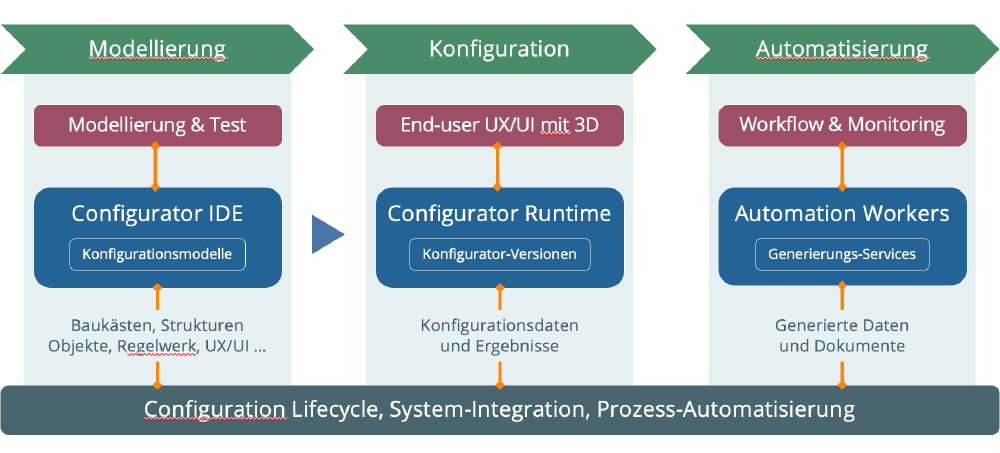
The open architecture supports end-to-end variant management, i.e., order acquisition and order processing. Typical applications: catalogues, guided selling, requirements capture, solution comparison, configuration, 3D viewing, calculation, simulation, engineering, digital twin, planning, work preparation, data and document generation for logistics, production and services.

This is the application layer – and what's the IT perspective? It’s not possible to connect many isolated solutions expensively via direct interfaces. State of the art: loosely coupled systems, web services, and modules based on middleware components and open standards.

The optimal system-level implementation is necessary, however, managing complexity and variety is not purely an IT discipline. A genuine cultural change must succeed in order to also master the far-reaching organisational challenges: away from departmental silos, data silos and waterfall – towards agile interdisciplinary collaboration and thinking in core processes.


Modelling environment: A collaborative tool for agile teams

Integrated Development Environments (IDEs) already offer a wide range of basic functions and can be flexibly adapted to specific requirements using plugins. Typical functions include: structuring projects, defining classes and objects, editing data structures and tables, modelling rules and processes, and designing user interfaces. Furthermore: automated processes for import/export, version control, test automation, and deployment to operating environments. The best available tools and targeted individual optimisations increase the productivity of each individual and create the necessary foundation for effective collaboration in interdisciplinary teams.

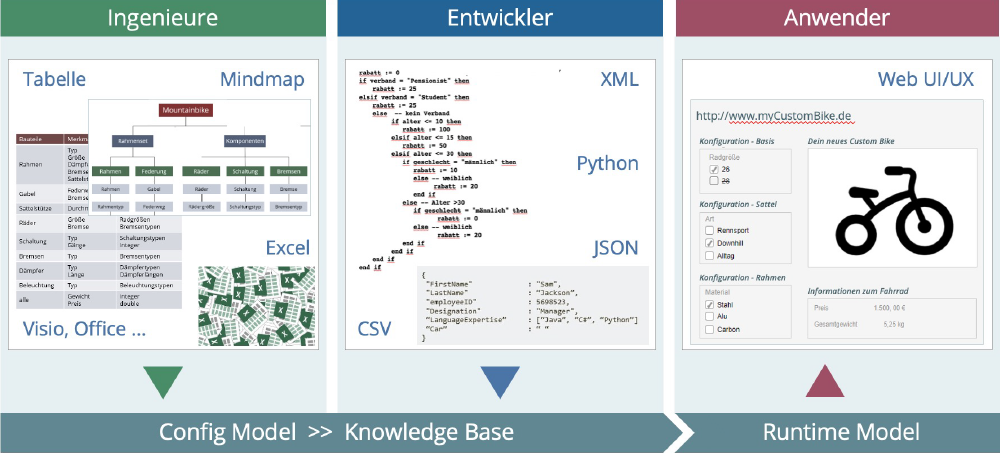
Configuration models can be modelled in different ways, depending on the complexity of the models and the technical background of those involved:

  • Tool-based methods addressing engineers and technicians. Modelling is carried out using mind maps, tables or graphical editors for calculations and rules, for example. A major advantage: easy and quick to learn without programming knowledge. However, graphical tools often reach their limits as model complexity grows.
  • Code-based Methods are preferred by IT-savvy users. Modelling is done using domain-specific languages or scripting, for example. Although programming skills are not necessary, they do facilitate a faster start. A decisive advantage: this approach allows for the precise mapping of models of any size and very complex relationships.

Every good method comes with its challenges: regular coordination between departments and implementation tie up resources. Modelling, testing, and operation require expertise, time, and care. Continuous development and model maintenance must function over extended periods. Graphical modelling often reaches its limits. Large models can quickly become very unwieldy. However, these challenges can be well addressed and there are solutions.


adesso mis variant management

Modern modelling tools support alternative working methods based on unified data models. Heterogeneous teams use flexible tools throughout the entire lifecycle: modelling, testing, quality checks, release management, and rollout. Clear responsibilities and regular team reviews support maintainability, further development, and operational reliability throughout the entire period of use.


Conclusion: Mastering complexity requires professional tools

Current innovations are opening up new possibilities for variant configuration. Modern configuration systems make complex products and knowledge models manageable and enable far-reaching modularisation, integration and automation of processes. Open standards, platforms, integrative middleware and flexible tools overcome the limitations of classic legacy suites and promote modular architectures, data consistency and seamless end-to-end processes.

What happens next?

In Part 5 of our blog series, we discuss different application scenarios and present the most suitable configuration and modelling strategies for each. Current configuration systems provide diverse methods, tools, and functions for modelling. Therefore, it is all the more important to choose the right solutions – for specific application scenarios and the best possible user experience.

Andreas is Managing Director of adesso manufacturing industry solutions GmbH. He has many years of experience in software development and system integration in mechanical and plant engineering. His areas of expertise primarily include variant management and product, system and solution configuration

Andreas Liesche Managing Director of amis,Digital gearbox visualisation in a digital factory

Andreas Liesche

e-mail: andreas.liesche@adesso-mis.de