Modelling Methodology: Modularisation and Technical Implementation
For effective and efficient modelling and application of complex product, system, and solution configurators, alternative methods, tools, and functions are available in an open and powerful system environment.
Configurators are based on structures, objects, classes, tables, features, values, dependencies, and UI definitions. CPQ additionally manages customers, contacts, quotes, line items, pricing rules, reports, and document templates. In production use, master data, rule sets, projects, and documents are exchanged with external systems.
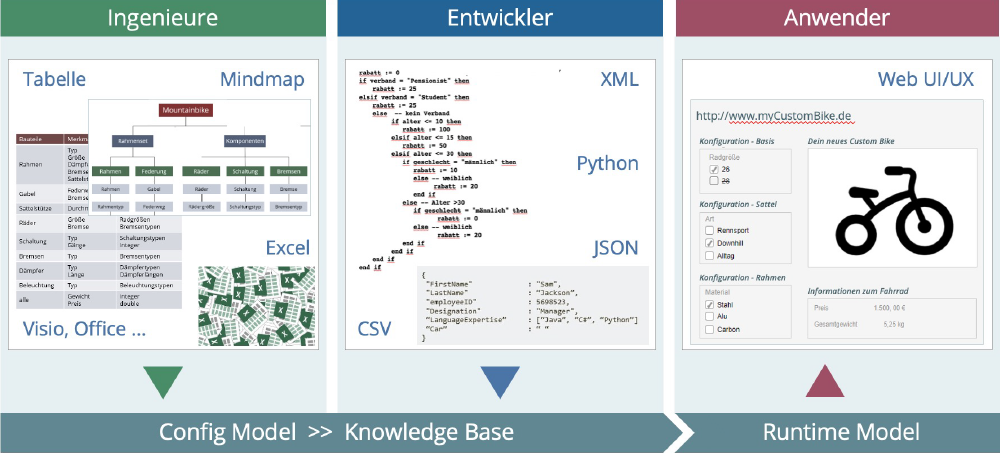
Keeping configuration models up-to-date, stable, and transparent throughout their entire lifecycle is a demanding challenge. Mastering the increasing complexity requires modularising and versioning configurators into manageable modules. For the modelling of structures, objects, and relationship knowledge, there are a wide variety of tried-and-tested methods and tools.
Current technologies allow configuration models of any size to be modelled, tested, deployed productively and scaled: master data management, high/low-level rule sets, model-driven UX/UI generation, optimisation for different user roles, diverse front-end/back-end systems – developed with innovative tools and orchestrated as open configuration frameworks.
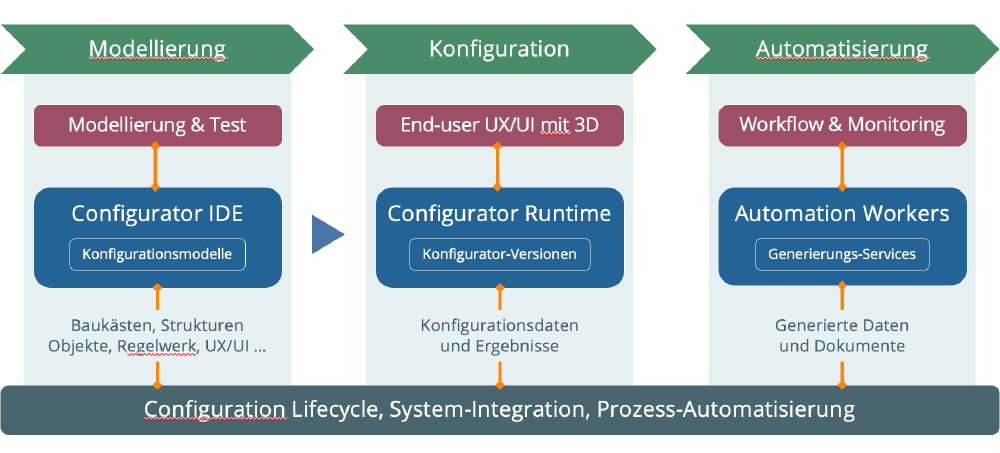
What system architecture and components does an open, modular configuration system require for successful projects? The diagram shows the typical structure: modelling environment, lifecycle management, interactive configuration, integration of involved IT systems, and automation of business processes.